
So-Brite
Permanent Lights vs String Lights
May
Every installer has run into the same moment – a customer loves the look of festive roofline lighting, but the conversation quickly turns to maintenance, seasonality, and budget. That is where permanent lights vs string lights becomes more than a style debate. It becomes a business decision that affects labor, callbacks, margins, and long-term customer value.
For contractors and lighting dealers, the right recommendation depends on the property, the client’s goals, and the type of recurring revenue you want to build. Both options have a place in the market. But they serve very different purposes, and understanding that difference helps you position your offering with more confidence.
Permanent lights vs string lights: the core difference
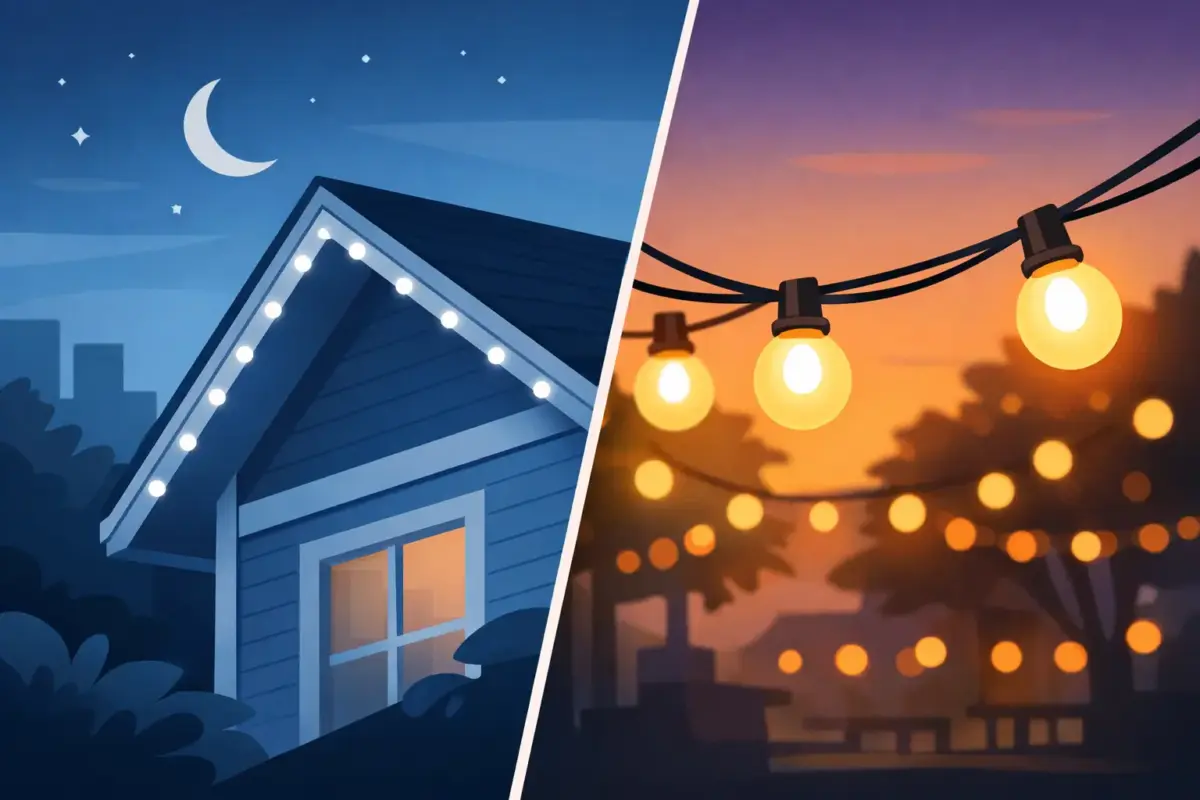
At a glance, both products put decorative light on a structure or outdoor space. That is where the similarities start to fade. Permanent lights are designed as a built-in exterior lighting system. They are mounted in a way that stays in place year-round, often tucked under eaves or integrated into the architecture for a cleaner daytime appearance. Most modern systems also include app control, color-changing capabilities, scheduling, and scene customization.
String lights are simpler by design. They are usually temporary or semi-permanent fixtures, whether used for holidays, patios, events, or accent lighting. They are visible, familiar, and relatively quick to deploy. In some settings, that is exactly the right answer. In others, it limits what you can charge and how much long-term value you create.
If you are building an exterior lighting business, this distinction matters. One product is often a one-season decoration. The other can become a permanent upgrade with year-round use cases.
What customers are really buying
Homeowners do not just buy lights. They buy convenience, curb appeal, customization, and fewer headaches. Commercial clients are thinking about visibility, branding, safety, and consistent presentation. When you frame the conversation that way, permanent lighting usually moves into a different category than traditional string lights.
A permanent system gives the customer one installed solution for holidays, game days, special events, everyday accent lighting, and even subtle architectural effects. That expands the value proposition well beyond December. It also makes the higher upfront price easier to justify because the product does more work throughout the year.
String lights tend to win when the goal is narrow. If a customer wants a classic patio atmosphere, temporary holiday decor, or a lower-cost visual upgrade, string lights can be a solid fit. They are accessible and familiar. But they rarely deliver the same level of integration, control, or premium finish as a permanent roofline system.
Installation and labor are not the same game
From an operational standpoint, permanent lights vs string lights is a major difference in how your crews spend time and how your business earns.
Permanent lighting installs usually require more planning upfront. You are measuring rooflines, accounting for power and controller placement, managing clean wire routing, and making sure the finished look aligns with the property. The install is more technical, but it also creates a higher-ticket project that better reflects professional labor and system design.
String lights can be faster to install, especially for temporary seasonal jobs. That speed can be useful if your business depends on high-volume holiday work. The trade-off is that temporary installs often come with removal, storage coordination, replacement bulbs or strands, and more service friction over time. Faster does not always mean more profitable once you factor in repeat truck rolls and shorter service life.
For dealers looking to expand their offering and increase revenue, permanent systems often support a stronger business model. They create a premium category, improve perceived expertise, and open the door to add-on sales like landscape lighting, pathway lighting, wall washing, and control upgrades.
Durability, weather exposure, and callbacks
Outdoor lighting lives in a tough environment. Sun, rain, wind, snow, heat, and freeze-thaw cycles all test product quality. This is one of the clearest dividing lines between permanent systems and standard string lighting.
Professional-grade permanent lights are built for year-round exterior exposure. When the housings, wiring, connections, and mounting components are designed for outdoor permanence, you get better reliability and fewer surprises. That matters for your reputation just as much as your margin.
String lights vary widely in quality. Some commercial-grade options perform well in patios and event spaces, but many products on the market are not built for the same long-term exterior demands. Even when they are rated for outdoor use, they are often more exposed, more visible, and more vulnerable to sagging, bulb damage, or wear at connection points.
The business impact is straightforward. If the product fails early or looks messy after a season, your customer does not just blame the lights. They blame the installer who supplied them.
Appearance matters in the sales process
A lot of buying decisions come down to how the system looks at noon, not just at night.
Permanent lights have a strong advantage here when they are designed to stay discreet during the day. Hidden or low-profile mounting under eaves gives homeowners the benefits of decorative lighting without the visual clutter of traditional strands hanging from the roofline. That is a major selling point in upscale neighborhoods, HOA-regulated communities, and commercial properties that want a clean exterior.
String lights are more visible by nature. On patios, pergolas, dining areas, and event spaces, that visibility can actually be part of the charm. Exposed bulb string lighting creates a social, hospitality-driven look that permanent architectural lighting does not replace. So this is not a case of one option beating the other in every setting. It is about using the right product for the right visual outcome.
Controls, customization, and year-round use
Technology is one of the biggest reasons permanent lighting has grown so quickly.
Customers increasingly expect app-based control, color selection, brightness adjustment, scheduling, and preset scenes. A permanent system can shift from warm white accent lighting to holiday colors to team colors to event themes without any reinstall. That makes the product easier to sell because it solves multiple needs in one package.
Traditional string lights usually do less. In many cases, they are either on or off, with limited dimming or color options unless you move into more advanced specialty products. That can be enough for a café patio or backyard entertaining zone. It is less compelling when the customer wants a dynamic, smart-controlled exterior system they can use all year.
For dealers, smart features do more than impress customers. They help justify premium pricing and position your business as a provider of modern lighting systems rather than commodity decoration.
Profitability depends on the model you want to build
If your business is chasing short seasonal volume, string lights can still play a role. They can help fill install calendars, support event-focused work, and offer a lower-entry service for budget-conscious customers. There is demand there, especially in hospitality and outdoor living projects.
But if your goal is to build a scalable lighting division with stronger margins and more differentiated offerings, permanent lighting tends to create a better platform. The average ticket is higher. The customer sees it as a property upgrade, not just a holiday expense. And the install can lead naturally into additional lighting categories.
This is where a broad product catalog becomes an advantage. A dealer who can offer permanent holiday lighting, roofline lighting, landscape systems, pathway lights, strip lighting, and café string lights is in a stronger position than one trying to force every customer into the same answer. So-Brite’s approach reflects that reality: empower dealers with premium products across categories so they can sell the right system, not just the available one.
When each option makes sense
Permanent lights are usually the right fit when the customer wants a clean daytime look, year-round functionality, smart controls, and a premium result that adds property value. They are especially strong for homeowners who are tired of seasonal installation cycles and for commercial clients who want a polished, consistent exterior presentation.
String lights make sense when the budget is tighter, the look should remain visible and decorative, or the application is tied to patios, events, dining spaces, and temporary seasonal use. They also work well as a complementary product. A dealer might install permanent roofline lights on the home and café string lights in the backyard entertaining area. That is not competition. That is a bigger project.
The best sales conversations do not frame this as a winner-take-all decision. They frame it as matching product type to use case, expectations, and long-term value.
The smarter way to position the sale
When customers ask about permanent lights vs string lights, they are often asking a deeper question: what is the best investment for my property? Your job is to answer that with clarity, not just with a price sheet.
Show them how permanent systems reduce seasonal hassle, improve curb appeal, and create more uses across the year. Show them where string lights still shine, especially in hospitality-style spaces and lower-commitment projects. When you position both honestly, you build trust and close better-fit jobs.
The contractors who win in this market are not just installing lights. They are helping customers choose systems that perform, look right, and make sense financially. That is how you protect margins, reduce callbacks, and grow an exterior lighting business with staying power.
The strongest offering is not the one with the most options on paper. It is the one that lets you recommend the right solution with confidence and turn one lighting project into a long-term customer relationship.
