
So-Brite
Permanent Soffit Lighting Review for Installers
Jul
The fastest way to lose margin on an exterior lighting job is to install a system that looks great on day one and turns into a service headache by season two. That is why any permanent soffit lighting review worth reading has to go beyond brightness and color options. For installers and growing lighting businesses, the real questions are about reliability, install efficiency, control stability, clean curb appeal, and whether the product helps you build repeatable profit.
Permanent soffit lighting sits in a different category than temporary holiday clips or basic accent strips. It has to perform year-round, disappear into the architecture during the day, and still deliver enough output and control flexibility to justify a premium sale. If you are evaluating systems for your business, the best review is not the one with the flashiest demo. It is the one that tells you what holds up in the field.
What a permanent soffit lighting review should actually measure
Homeowners tend to focus on effects. Dealers and contractors cannot afford to stop there. A strong system has to win in five places at once: product durability, install simplicity, app reliability, daytime appearance, and long-term serviceability.
Durability starts with the obvious issues – weather exposure, UV resistance, water ingress, and connector quality. But the less obvious details matter just as much. If a track warps, if color output shifts over time, or if power injection becomes inconsistent across longer runs, you are the one absorbing callbacks. Professional-grade systems separate themselves with stable components, better sealing, and hardware designed for real exterior use rather than light-duty seasonal performance.
Install simplicity has a direct effect on margin. If your crew needs extra fabrication time, awkward mounting workarounds, or constant troubleshooting between sections, your labor cost rises fast. Good permanent soffit lighting should have a mounting method that is predictable, extension and accessory options that fit normal field conditions, and controller integration that does not require a support call on every job.
The control experience matters too, because homeowners buy convenience as much as lighting. If the app is clunky, scheduling is inconsistent, or zone management is limited, your premium sale starts to feel average. On the commercial side, this becomes even more important. Property managers want dependable control, not a gadget.
Permanent soffit lighting review: where premium systems pull ahead
The difference between entry-level and premium systems is usually not dramatic on a short showroom test. It shows up over months of use and across multiple installs. Premium products tend to deliver cleaner color consistency, stronger materials, more reliable smart controls, and a better finished look along the roofline.
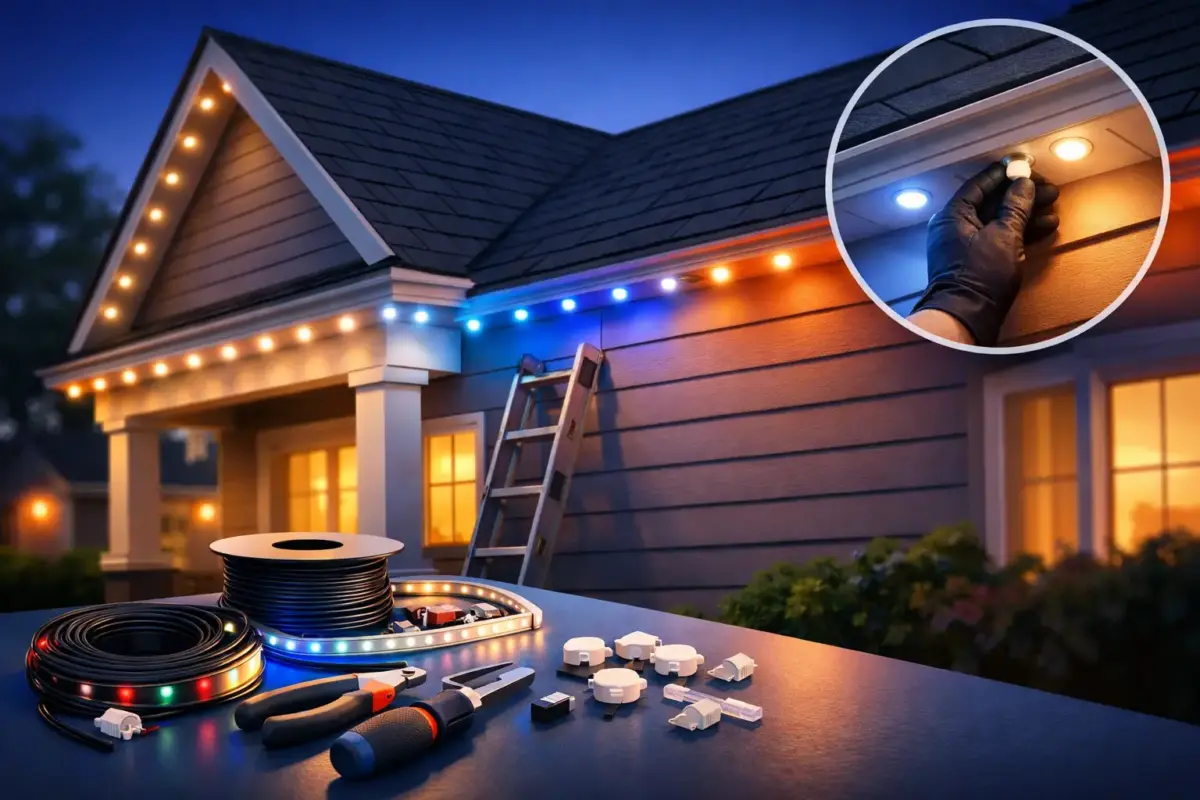
That finished look is a bigger deal than many new installers expect. The best permanent soffit systems are designed to stay visually quiet during the day. HOA-conscious customers and higher-end homeowners do not want a bulky add-on that advertises itself in sunlight. A low-profile track or discreet fixture placement supports the sale because it solves the main objection before it comes up.
Premium systems also tend to be easier to scale across different project types. A residential ranch home, a two-story custom build, and a small retail frontage all create different power, spacing, and controller demands. If your supplier offers a broad catalog that includes compatible accessories, cable lengths, caps, power boxes, and complementary exterior lighting, you spend less time patching together solutions from multiple vendors.
That sourcing efficiency is not a side benefit. It is a business advantage. Fragmented purchasing slows down operations and creates failure points. Dealers who want to expand their offering and increase revenue need systems that can be installed consistently and replenished quickly.
Performance in the field: what installers notice first
In real-world installs, the first thing crews notice is whether the system behaves the same way from house to house. Consistency is what allows you to train efficiently and quote with confidence.
Mounting hardware is usually the first test. If the track or housing aligns cleanly under soffits and eaves, jobs move faster and the final result looks intentional. If the product fights the structure, labor hours add up. This is especially true on homes with uneven fascia lines, multiple peaks, or mixed materials.
The second test is controller setup. Many systems promise easy app control, but field experience can be uneven. Strong platforms keep pairing simple, support reliable scheduling, and offer enough scene flexibility to satisfy customers without creating confusion. You want control software that helps you close jobs, not software that turns every handoff into a mini training session.
The third test is service exposure. No permanent system is completely immune to issues. The question is whether maintenance is manageable. Can sections be isolated easily? Are replacement components available without long delays? Can your team diagnose power or connectivity issues without tearing apart half the install? Products built for dealer success make those answers easier.
The trade-offs to watch before you commit
A fair permanent soffit lighting review has to acknowledge that every product choice comes with trade-offs. Lower-cost systems can help win price-sensitive jobs, and there is a place for that in some markets. But lower acquisition cost often brings thinner margins once labor inefficiency, support time, and replacement risk enter the picture.
On the other hand, a premium system only works if the value is clear to the customer and the install process supports profitability. If your market is heavily driven by lowest-bid shopping, you may need a tighter sales process to position year-round use, app control, architectural appearance, and long-term durability as real differentiators.
There is also a design trade-off between subtle daytime appearance and maximum output. Some discreet systems blend beautifully into soffits but produce a more refined effect rather than an aggressive wash of light. That is usually a positive for upscale residential jobs. For highly visible commercial facades, you may want to pair soffit lighting with wall washers, landscape fixtures, or other accent products to create a fuller result.
This is where supplier breadth matters. A one-product strategy limits your options. A broader exterior lighting lineup gives you room to design for the property instead of forcing every project into the same package.
How to evaluate a system before you make it part of your business
If you are serious about adding permanent soffit lighting or replacing an underperforming line, review it through the lens of operational fit. Start with sample quality, but do not stop there. Ask how the system handles long runs, what accessories are available, how fast replacement parts can be sourced, and whether the supplier is built to support dealers rather than one-off retail buyers.
Then look at install workflow. How many crew hours does a standard home require? How clean is cable management? Are the components packaged in a way that helps field teams work efficiently? Saving even a small amount of labor on each project compounds quickly over a season.
Next, evaluate whether the product helps you sell a broader solution. Permanent soffit lighting is rarely just a single-service opportunity. It can open the door to landscape lighting, pathway lights, café lights, wall washing, and seasonal upgrades. That matters because the best lighting businesses do not chase one transaction. They build an expandable service line.
For dealers in markets with strong residential growth and high curb-appeal expectations, including areas around Phoenix where homeowners care about both aesthetics and heat durability, premium weather-ready systems make even more sense. Environmental stress reveals weaknesses quickly.
The business case matters as much as the light output
A lot of reviews stop at product features. For contractors, that is not enough. You need to know whether a system supports revenue growth.
The right permanent soffit lighting line should help you quote confidently, install efficiently, and create a result customers want to show off. That last part is not fluff. Exterior lighting sells visually, and strong nighttime impact drives referrals. A clean install that disappears during the day and performs year-round gives customers a reason to talk about it well beyond the holiday season.
It also supports recurring business. Once a homeowner is comfortable with smart exterior lighting, it becomes easier to sell upgrades, additional zones, and complementary products. Commercial clients may start with facade lighting and expand to pathways or feature areas later. That is where dealer-focused suppliers bring real value. The product is only part of the equation. The ability to source consistently, expand your catalog, and rely on support is what turns installs into a scalable business.
Brands built around Empowering Dealers understand this better than companies selling commodity lighting. A premium system should not just light a soffit. It should help grow the company installing it.
If you are weighing options, do not ask which system has the most effects. Ask which one gives your team the best chance to deliver a clean job, avoid callbacks, protect your reputation, and expand your offering with confidence.
