
So-Brite
Permanent Lighting vs Holiday Lighting
Jun
Every installer has seen it happen. A customer calls in October asking for roofline lights, wants the job done fast, and then disappears in January until next season. That is the real tension in permanent lighting vs holiday lighting. One model creates a short seasonal rush. The other can become a year-round revenue stream with stronger retention, cleaner operations, and more upsell potential.
For dealers and contractors looking to grow, this is not just a product decision. It is a business model decision. The right mix affects scheduling, labor efficiency, customer lifetime value, and how easily you can expand into residential and commercial projects.
Permanent lighting vs holiday lighting: what changes for your business?
Traditional holiday lighting is familiar. You install temporary lights for a season, remove them after the holidays, store materials, and repeat the cycle next year. It can produce quick cash flow during a concentrated window, especially if you already have crews and ladders in place.
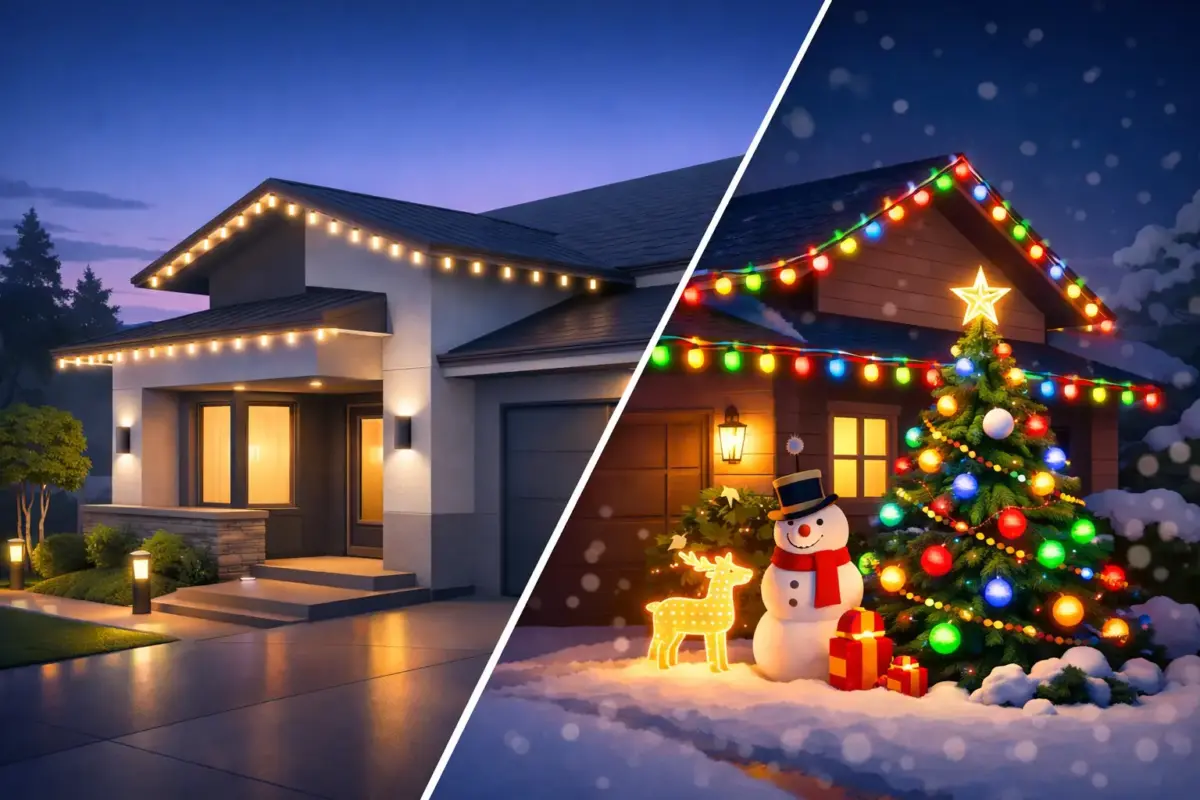
Permanent lighting shifts the conversation. Instead of selling a one-season decoration, you are selling a built-in exterior lighting system designed for year-round use. Customers can run holiday colors in December, team colors on game day, soft architectural lighting the rest of the year, and custom scenes for birthdays, events, or commercial promotions. That means the product stays relevant after the holiday season ends.
For a dealer, that changes the value proposition from a temporary service to a long-term lighting upgrade. It also opens the door to other categories like landscape lighting, pathway lighting, wall washers, café string lights, and smart controls.
Why permanent systems are gaining ground
The strongest argument for permanent lighting is simple. It solves the biggest friction points that come with seasonal installs.
Customers do not want the annual hassle of booking installation, waiting for removal, and dealing with burned-out strands or inconsistent looks from year to year. Property owners also want cleaner curb appeal. Modern permanent systems are designed to sit discreetly under eaves or soffits, staying HOA-friendly and nearly invisible during the day.
That creates a stronger sales story for premium buyers. You are not asking them to rent a holiday look every winter. You are offering convenience, durability, smart control, and all-season flexibility.
For installers, the operational benefits matter just as much. A quality permanent system reduces recurring truck rolls tied to removal, storage, restringing, and replacing damaged seasonal products. You still need service capability, but the labor profile is different. Instead of repeating the same install and takedown cycle, you can focus on new jobs, upgrades, and cross-sells.
The case for holiday lighting still matters
That does not mean temporary holiday lighting is obsolete. For many companies, it remains a useful service line.
Some customers are price-sensitive and are not ready for a permanent investment. Others only care about a short holiday display and have no interest in year-round lighting. There are also markets where temporary installs are still highly profitable because demand spikes quickly and competition is fragmented.
Holiday lighting can also be an entry point. If a contractor is new to exterior lighting, seasonal work may feel easier to start because the sales cycle is familiar and the project scope is straightforward. It can generate fast leads, local visibility, and repeat seasonal customers.
The trade-off is that this model often creates a compressed revenue season and a heavy dependence on labor availability during a short timeframe. If weather turns, crews get backed up, or material quality is inconsistent, margins can tighten fast.
Margin potential and revenue stability
If your goal is to expand your offering and increase revenue, permanent lighting usually wins on long-term economics.
A temporary holiday job often produces repeat annual work, but it also resets the sales process every year. You are managing scheduling pressure, storage, repair, removals, and the cost of seasonal labor. The business can be profitable, but it tends to be operationally intense.
Permanent lighting gives you a larger upfront ticket and a more durable asset to sell. It also supports add-on revenue. Once a homeowner or commercial client sees app-controlled color changes on the roofline, it becomes easier to introduce landscape uplighting, pathway lights, soffit accent lighting, or lighting for patios and entertainment areas.
That matters because strong lighting businesses are rarely built on one product alone. They grow by stacking services around a trusted exterior lighting system. A dealer with access to a broad, dependable catalog is in a much better position to do that than a contractor piecing together products from multiple sources.
Installation complexity and crew efficiency
There is an assumption that permanent systems are harder to sell and harder to install. That depends on the product line and the support behind it.
A well-designed permanent lighting system should be dealer-friendly. Weatherproof components, clean mounting options, dependable connectors, extension cable options, and intuitive controllers all reduce installation friction. Smart app controls also improve the homeowner experience, which cuts down on confusion after the job is complete.
Temporary holiday installs can look simpler, but they come with repeat labor every season. You may be climbing the same home multiple times each year, dealing with clips, strand failures, and weather-related wear. That is manageable when volume is high and crews are trained, but it does not always scale gracefully.
Permanent lighting asks for precision upfront. Once installed correctly, though, it can free your team from a cycle of seasonal repetition. For companies trying to build a more predictable schedule across the year, that is a major advantage.
Customer expectations are different
In permanent lighting vs holiday lighting, the sales conversation changes because the buyer mindset changes.
A holiday lighting customer is usually shopping for a seasonal experience. They may compare price first, visuals second, and convenience third. A permanent lighting customer is making an upgrade decision. They are more likely to ask about durability, control options, daytime appearance, warranty expectations, and year-round functionality.
That means your sales process needs to be more consultative. You are not just quoting linear feet. You are demonstrating lifestyle value, property enhancement, and the convenience of custom scenes controlled from a phone or tablet.
For commercial buyers, the value can be even stronger. Restaurants, retail centers, HOAs, event venues, and office properties can use permanent lighting for holidays, promotions, brand colors, and everyday curb appeal without bringing in a crew every few weeks.
Where each option fits best
Holiday lighting still makes sense when a customer wants the lowest upfront commitment, only cares about a short seasonal display, or is testing the category before making a larger purchase. It can also work well for businesses that intentionally want a high-volume, seasonal service model.
Permanent lighting is the better fit when a customer values convenience, wants a cleaner architectural look, expects smart controls, or is interested in using lighting beyond the holidays. It is especially attractive for homeowners in higher-end neighborhoods and commercial properties that want a polished, flexible system that stays in place.
For many dealers, the best answer is not choosing one or the other exclusively. It is using holiday lighting as a lead generator while building permanent lighting as the higher-value core offering. That approach gives you an entry-level service and a premium upgrade path.
Building a stronger exterior lighting business
The bigger opportunity is not merely winning the holiday season. It is becoming the contractor customers call for every exterior lighting need.
That only happens when your sourcing is reliable, your product quality is consistent, and your catalog supports more than one kind of project. A dealer program built around premium permanent lighting, landscape lighting, controllers, power boxes, and installation accessories gives you room to scale without stitching together products from different vendors.
That is where a partner like So-Brite aligns with growth-minded installers. The advantage is not just access to product. It is the ability to offer professional-grade systems that are easier to sell, easier to install, and easier to build a business around.
If you are deciding between permanent and seasonal lighting, think beyond this year’s busy season. The better question is which model helps you create repeatable revenue, stronger margins, and a broader service lineup your market will keep buying. The contractors who win long term are the ones who stop chasing one season and start building a lighting business customers can use all year.
